Sunday, 10 January 2016

If you are in Kathmandu and want some adrenaline rush, plan a hike to Kalinchowk


Mountain range, as seen, from Kalinchowk.

I don’t believe in superstitions. But don’t know why, it seems that if I hike and travel on the first day of the year, the spirit will continue throughout the year.

Keeping up with the tradition of travelling to new destinations on the first of January, along with my two friends Dilli and Deb, I set out for a hike to Kalinchowk, a famous religious and touristic spot in Dolakha district.  

One thing special about the trip was no substantial planning involved. Now ask me why I believe in such an old philosophy of procrastinators. Let me tell you – it makes the journey more unpredictable and filled with surprises.  

The unofficial blockade has blocked the veins of economy. But people have no complaints.
The journey to Charikot in a public bus was a memorable one. We started at 9:30 am from the Old Bus Park and it took us seven hours to reach Charikot. On the way, the bus stopped a zillion times to accommodate the local passengers. One of the reasons for such a crowd in the bus was the fuel scarcity due to the unofficial blockade. Half of the bus corridor was filled with 50-litre jerry cans carrying diesel and other half with passengers, packed like sardines. At places people even got up the bus roof-top with loads of firewood. Not to mention, it was already packed with travellers.

As we got down the bus for snacks in the mid-way, the restaurant owner quickly heated the chick-peas and potatoes over a firewood stove. He had no qualms about using up the precious firewood in the wake of the cooking gas shortage and he did not charge more than usual for this extra service.

Back in the bus, the old people, ladies with little children all clung to each other while some rested on the seats. Even little children were standing along with their parents. But still they were cracking jokes – about the hardships they had to face due to the unofficial blockade. They had no complaints – neither against India nor the current government. The whole bus was making its way through the narrow roads in a jolly mood.  

A frog’s leap for locals is more than leapfrogging for outsiders
Entering the Dolakha district, we could see the buildings destroyed by the 25 April earthquake and people living in temporary shelters. The landscape was a beauty to watch but the rubble and the shelters were like lesions on a soft skin.

Finally after seven hours’ ride we reached Charikot. Finding a place for the night was another big task in the New Year eve. Although the hotels were booked and packed with new arrivals, we got a nice deluxe room in a reputed hotel.

Another big and arduous task in front of us was to find the right suggestion to get to Kalinchowk. Everybody we talked with suggested hiring a jeep to Kuri. Although the distance from Charikot to Kuri is only 18 kilometres, nobody advised us to hike. The didi at the hotel where we stayed said that it would take us more than five hours to reach Kuri and additional one hour to reach Kalinchowk from there.

The next morning we set up for the hike – decided not to hire any vehicle to Kuri. However, as we were sipping tea in a road-side café, luckily we met the president of the local transporters’ association. He advised us not to go on foot and said it would take seven hours to reach Kuri. The number of hours needed to reach Kuri had increased with each person we consulted. According to the first person we consulted, Kuri was only three and half hour away from Charikot. Thus, after talking to the president, we decided to take a jeep ride one way and he helped us connect to one of the local drivers.    

A tea-house in Kuri.

Luckily, in next one hour we were at Kuri. Everything was happening as per our sporadic plans and in a way it was much better than planning everything in advance.

We saved almost five hours that, otherwise, would have been spent in hiking uphill. For the locals the ascent takes 3.5 hours, but even for brisk walkers like us, it would have taken more than 5 hours.

Thus, we learnt an important lesson: Always add an hour and half to what the locals say it will take, if you are planning an uphill hike. For the locals it might be a frog’s leap but the same, for you, might be a never-ending trek.  

Kuri village, as seen, from Kalinchowk.

Reaching Kuri on time had its own benefits. We utilised the saved time well. Spending more than an hour on the peak, clicking as much pictures as we could were the bonus of reaching earlier at the hill-top.

The Mount Gauri Shankar (7,134m) and other peaks seemed standing just next to us. The cool breeze atop the hill was soothing and relaxing, especially after the tedious, almost 80 degrees climb for an hour.
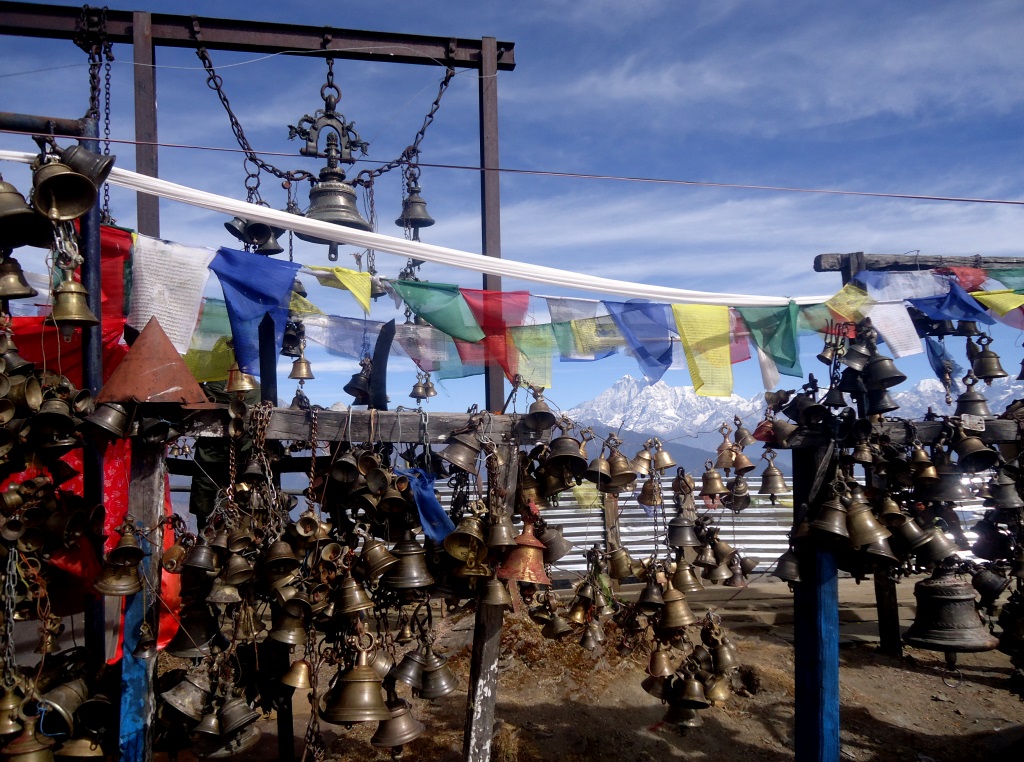
Bells and bells everywhere - the offerings from the worshipers.

Once you reach the top (3800m), you get to understand why the Shakti Peeths (the place of worship, highly valued by the Hindus) are located at inaccessible places. The place is free from unwanted crowd, pollution and whatever dirt the mankind produces at easily accessible places.

Apart from bells, tridents are offered to Kalinchowk Bhagwati.

We will never get over with the Hindi music
While reaching the hill-top was bliss with no trace of pollution, the bhajans blaring out of the loudspeaker was piercing our ears. And imagine – all the chants were in Hindi language, dubbed copies of latest Bollywood hits. Not to mention, the songs with hints of sexuality.

I wonder when we will start promoting Nepali bhajans. All the time we talk about taking pride in being a sovereign country and banning Hindi movies and television channels but forget that Indian-ness has penetrated skin-deep. It won’t go away that easily.

The black marketers need to learn lessons on humanity from Kuri hoteliers
While the ascent was difficult even for regular hikers like us, descending down the peak was a much easier task.

If you pile up the stones, it will keep away your joint-aches.

Reaching the base, we searched for our Sherpa friend who had accompanied us in a jeep to Kuri from Charikot. To our surprise, everyone in the small bazaar seemed to know each other and they happily helped us find his lodge. What a shame, we had not even bothered to ask his name during the one hour jeep ride. However, a man recognised him as we described his appearance. He said, “Oh, that must be Kanchha!”

And Kanchha Sherpa, he was. He came, leaving behind the clothes he was washing. With a big grin on his face, he said, “I thought you guys won’t be back for lunch,” while his wife cursed him for not telling her to prepare lunch.

In a jiffy she prepared snacks for us. Imagine lighting up the improved cookstove and cooking food. But for her it was a daily chore and in no time we were gulping down the egg noodles. When it was time to pay, we were dumfounded – it was much cheaper than in Kathmandu!

In spite of the unofficial blockade and the difficulty to get the commodities to that height, the prices had not skyrocketed as in the capital. We could imagine how greedy the Kathmandu businessmen had been.

They need to learn a lesson or two from these relatively poor but honest businessmen!

Kathmanduites still need to learn to be social
While we were going gaga over the good people in Kuri, we had to face few thorns in the way.
We knew it would take us around five hours to descend down to Charikot from Kuri as we hadn’t booked any vehicle for the return trip. Luckily, a Bolero with a back carrier appeared from nowhere. 

We were more than happy and excited as we were, asked the people sitting in the front for a hitchhike. Though the jeep had been reserved, they were okay with it and asked us to jump on the back carrier. However, a girl and a boy sitting at the back acted snobbish and said, “No, there’s no place, you guys can’t hop in like anybody.”

And the boy wasn’t even looking at us. As if we were some animals!

We knew the team was from Kathmandu. And the message was loud and clear – they needed a lesson or two to be social!

Climate change is real. And it’s happening.
Saddened by the behaviour of our fellow Kathmanduites, we marched towards the hiking route – as brisk as we could.

Rhododendrons ready to blossom ahead of the blooming season.

The walking route passed through a jungle of rhododendron. To our surprise, the bushes were laden with flower buds – they would bloom in a week or two. And it was just the first day of the year!

The rhododendrons bloomed only in March earlier. Then the blooming season shifted to February and last year the rhododendrons bloomed in mid-January. This year, it would bloom much earlier. The change was there, right in front of our eyes – the real climate change. And it was happening. In the broad daylight!

It’s the motivation that matters. Be surrounded by optimists.
A good thing about walking back was the experience – the walk up the hills and the following descent. On the way, we met three young guys – tired both spirit-wise and fitness-wise. They had been walking for seven hours and hadn’t met anybody to up their near-dead spirit. Somebody had suggested that it was only a three and half hours walk to Kuri from Charikot – same was what had been suggested to us.

Still they were half an hour away from Kuri, the base camp to Kalinchok. We knew, for sure, they won’t be able to make to the top that day as the temple gates closed at 4 pm. Seeing us, their faces brightened up. They were face-to-face with another trio that was returning from the summit!

When we said that they were only half an hour away from the base camp their spirits suddenly charged up. We, too, were happy to meet the youngsters. We told them about Kanchha Sherpa and his lodge where they could put up that night and set for the hill-top the next day. They were more than happy and as they bid goodbye, one of them said, “Dai, had we not met with you, we would have left the hope to get to Kuri today.” Such is the power of optimism and being surrounded by optimists.

The earthquake not only took down the buildings but also shattered the human egos
As we returned to the hotel in Charikot, we had a chat over a cup of coffee with a local hotelier. The couple had left their hotel business after the 25 April earthquake and was sustaining the family from the earnings of a small tea shop.

Most of the buildings near the shop had visible cracks, few had fallen down and people were still getting rid of the rubble. The lady was telling how hard the life was after the earthquake. “The earthquake taught a great lesson to us all,” the man added. “All the tall buildings had been built from bank loans just to compete with the neighbours with high-rise buildings. The earthquake not only took down the buildings but also shattered the human egos. Now all of them are back on the streets.”

How to get there
If you have your own vehicle it takes one hour to get to Dhulikhel from Central Kathmandu and from Dhulikhel you can reach Charikot in three and half hours. From Charikot to Kuri it’s only 18 kilometres but as the road is uphill and bumpy it will take nearly one hour – make sure you are riding an off-road vehicle. From Kuri to the Kalinchowk hill-top is a forty-five minutes steep and arduous walk – if you keep on climbing without a break, otherwise it might take you an hour or more.

If you opt for public vehicle, you can get one from the Old Bus Park in Kathmandu. The journey to Charikot is of six hours and costs NRs 335 per person. The buses run at an interval of an hour and half and the first one leaves the bus stop at 5:30 am and the last one at around noon. From Charikot to Kuri you can either hire a jeep (six people can fit in the vehicle) for NRs 5,000 for a round-trip (but it will cost you NRs 3,700 one-way, if you plan to walk one-way) or hop into one run by the local transporters’ association for NRs 250 per person.  

Accommodation and food
In Charikot there are plenty of good hotels. However, it’s always good to book in advance in special occasions like New Year or any Hindu festival. Kuri has few lodges, tea shops and a grand new hotel. There’s no problem of getting good food. The hotels in Charikot charge a room from NRs 800 – 1200 and it’s much cheaper in Kuri. The food is cheap – NRs 200 is more than enough for a meal.  

Friday, 4 December 2015

Say ‘NO’ if you are offered venison in Nepal

The forbidden fruit always lures a man. And that’s why most of the non-vegetarians are fascinated by the idea of eating a wild animal. But have you ever wondered how the meat is procured? How do the profit-makers kill the poor animals illegally and how they cheat the buyers?

Bardiya National Park, Nepal’s largest park in the plains, borders with Surkhet district notorious for illicit trade of wild animal parts – deer meat being one of the most frequently traded items.  

Chital (Spotted deer). Image by Mahesh Balasubramanian.CC BY 2.0
If you travel from Kohalpur of Banke to Birendranagar of Surkhet, you will come across a stop-over “Babai”, at the banks of Babai River. There are small tea and snacks shops dotting over the road-side that sell hot meals to the travellers stopping by. And if you are a regular customer, they will ask, “Would you like to taste venison?”

However, think twice before eating the meat of a wild animal. I must have travelled via Babai to Surkhet more than 30 times. And most of the times, the shop-owners ask me to taste the delicacy of the day. But every time, my answer remains the same. A blunt “No”.

The poachers spray lumps of salt on grass patches frequented by deer. Then they spray Thyodene on the patches. After few days of exposure to the sun, the odour of the chemical normalises and when the deer come to the patches, they eat the salty grass. Due to the grass laced with poison, they die on the spot. The poachers then take away the carcasses and make dry meat. The meat is sold at an exorbitant price.


Himalayan langurs. Image by user Gautam. CC BY-NC-ND 2.0
However, if you are not a regular customer, chances are high that you will get duped. Instead of serving deer meat, they will give you langur meat. It’s sad that the langur population is declining as they get killed for the meat.

So, next time you are offered a plate of deer meat, say “No” and help save these beautiful species along with the innocent monkeys that get killed to replace deer meat.

Tuesday, 21 July 2015

And I was the last man to jump off to safety from the jaws of death

The Pulchowk bus station at Narayangarh was bustling with crowd – a mélange of people from hills, terai (plains) and foreigners back from Sauraha, the destination famous for sighting one-horned rhinos. The temperature was soaring at 36 degree Celsius and the air was humid, making everyone sweat perpetually. The Narayani River flowed gently nearby, with the vehicles screeching at the bridge to lower their speed. Policemen were loitering at the station, enquiring groups of people in between.

Adding to the sea of confusion, a bus from Bhairahawa, with a load of bananas and vegetables on the rooftop, stopped near the common ticket counter booking tickets to Kathmandu. People, waiting for the bus, hurried to embark the bus and grab the front seats – so that their journey till Kathmandu will be a comfortable one. Among them was a man with five goats – he got in the bus with the goats in the tow. As the goats bleated, the passengers cursed the conductor for allowing him to get in.

“Mommy!” “Mommy!”

A terrified baby started crying seeing the goats, while one of the goats started tearing at the shawl of the mother seated on the last row. She hit the goat with her elbow and it let go off the shawl. But whenever she looked elsewhere, the goat would again start its work. A game of hide and seek, between the mother and the goat, ensued.

The bus was full within minutes and the passengers were packed like sardines. The perspiration and smell of all different sorts started wafting like a concoction of strong rotten eggs and raksi, a home-made alcohol.

***                                 ***                                   ***                                   ***

A man next to me was chewing beetle leaf and used to lunge at the window to spit in between. The red spurts would splash on my face and clothes as he spat each time. In spite of the man’s audacity and my peaking vexation, I crushed my anger and remained a mere spectator.

All the passengers were asking the driver to start the bus, but the greedy conductor still wanted some more people who could travel sitting on the sacks of bananas and vegetables on the bus roof.

The bus operators never care for the comfort of the commuters but only for the money that they can squeeze out of them.

Then came an old man with a white cap, a silver goatee and a few days’ stubble which confirmed him to be a Muslim. He tried to get in the bus along with a basket of 10-20 chickens in it.

Not letting him in, the conductor started haggling over the fare.

"Hundred for you and 50 for your chickens," said the conductor.
"I will give you just 100, why are you charging for these chickens?" said the man meekly.
"Don't you know, they occupy a space that can adjust three men?"
"But they are not men, they are mere chickens."
"Fifty is not even a pinch of what should be paid," the conductor growled furiously.

The deal could not be struck. But the old man had just managed to get inside the bus door with his basket of chickens. Miffed by the altercation, the conductor grabbed the collar of the old man's kurta, disembarked him from the bus rudely, picked up the basket and threw it out of the bus.

The chickens, afraid, started clucking – adding to the cacophony.  

The old man was no match for the young conductor boy. The boy still managed to get some more men inside the bus. As the engine of the bus started roaring, the old man with tears in his eyes cursed, “You have mishandled a man of your grandfather’s age, the great Allah will punish you for your misdeed.” “Insallah!”

“To hell with you and your Allah!” shouted back the conductor and the bus sped on.

It was not fair. But none in the bus thought of confronting the ill-mannered guy. All were perched to their seats and nobody wanted to share the space with the old man and his chickens.

To the most Hindus in the bus – if not all – he was just a Muslim.   

***                                 ***                                   ***                                   ***

The Narayangarh – Muglin road section had lots of potholes and to add to the woes, the driving was reckless. The passengers at the back jumped with each bumps and jolts on the road. As the bus hit a bump, the goats would start bleating and passengers would scream “Ram Ram”. 

The bus left behind a cloud of dust which would finally settle on the trees and shacks by the road. I was feeling sorry for the soothing scenery and the river flowing by the road that provided some relief amidst the agony.

Besides, I was lucky to get a front seat. I had put my bag and sandals on the overhead rack and was reading the latest issue of Businessworld. The man sitting next to me wanted to break the ice and chat, but I kept mum. Still he disturbed me with his chewing and spitting.

At first I would take off my gaze from the magazine and look outside the window as and when the bus came across a jolt. But with a bump every minute or so, the curiosity died away. And I remained stuck to the magazine.  

As the bus crossed the bend after the famous Jalbire temple, the driver increased the speed. There might have been two reasons – Muglin, the next stop was nearby and a huge loaded truck was in front of us – with a driver adamant at not leaving the tarmac.  

Our bus driver was doing his best to overtake the truck and our ears were abuzz with the horn honking all the time. As he located a narrow strip, he sped the bus further and we were competing with the truck.

Then the only thing that we heard was a huge thud. And a complete chaos. Our bus had hit a post on the road boundary! 

***                                 ***                                   ***                                   ***
A bus stranded on the road between Narayangarh and Kathmandu after accident. Image from Flickr by Michael McDonough. CC BY-NC-ND 2.0

The bus was hanging by the boundary post. A scary see-saw it was. Thanks to the goats – their weight at the tail end was holding the bus from plunging down the hill into the river.

Some of the passengers had already jumped off the bus from the front door. Some were hanging to the trees with their skins slashed. Two women were crying at the back seat. The window had shattered and the glass pieces had cut their faces at several places.

Even in the death-at-the-sight moment I was able to grab my sandals and bag from the rack above my head. In a flash, I was jumping out of the opposite window.

Then somebody grabbed my t-shirt and hurled me back into the bus.

The man was in his 60s. “Please let my daughter jump first, she has a long life ahead,” he said and started helping her jump from the hanging bus.

Each second in the ill-fated bus seemed like a year to me. I was sweating like nothing and the fear of death was not letting me think anything rather than jumping out of the bus.

After his daughter, it was the man who took the turn to get out of the bus. A minute ago he was talking about giving chance to a younger girl to live and then he was ignoring a young man in his early twenties.

The bus was still hanging to the boundary post. When I jumped off the window, the upper window sill caught my t-shirt but still I was able to get off the bus. As I safely landed on the road, I could see that the bus was already empty. Nobody was inside, except the goats. They were still bleating. And this time, I knew it was because of the fear of death. But the din and hullabaloo out on the road overpowered it.

People care not for the precious lives but think themselves to be more precious than others.

Several thoughts preoccupied my mind and the most prevalent was the conversation between the old man with chickens and the conductor boy. The old man with his silver goatee and white cap would flash each time in front of my eyes as I turned towards the bus. And his words would echo in my ears, “You have mishandled a man of your grandfather’s age, the great Allah will punish you for your misdeed.” “Insallah!”

***                                 ***                                   ***                                   ***

It was 7 PM and was getting dark. The stranded passengers were waving hands and getting on to any vehicles that stopped for help. Luckily, four monks and I were picked up by a pick-up going to Kathmandu. We were the last ones to be rescued from the site.

As we left the scene, the bus was still hanging to the post and the goats – tired of bleating were whimpering. And the whimper, I knew, was scary. A sign of little thread of hope amidst the appearing death.

The pick-up, a jittery vehicle, was throwing billows of smoke behind. Amidst the darkness of the smoke, it seemed, the old man with white cap and silver beard was cursing the conductor. And I could see the man in his 60s tugging me by my t-shirt and pulling me back into the bus. I was comparing the tears in the old man’s eyes to the twinkle in the eyes of the latter.

The more I tried to remember, the more cunning the latter looked.

Passing the small town Muglin, we were back on tarmac with no potholes. The journey was smoother and the pick-up no more threw clouds of smoke behind. Till that time, I was getting familiar with the four monks, all dressed in orange and maroon. There was a sort of glow in their faces. Calm as sea they were.

When I asked from where they were coming, one of them quietly replied, “Bodh Gaya.”

I was more interested in them and as I chirped and chirped asking them more and more, the reticent men started talking – this time in one-liners instead of the one-words. They had been to the place of Buddha’s enlightenment. And enlightened they were.

After almost two hours’ ride, we arrived at Naubise – with the remaining journey reduced to 36 kilometres, an hour’s journey. As the vehicle stopped for late tea and snacks, I grabbed a packet of salt and sweet biscuits and started munching on it. The four monks remained in the pick-up. When I offered them the packet, they simply denied. I could feel the sense of fulfillment in their eyes.  

Then the scenes again started revolving in my head – the goats bleating, eating the women’s shawl, the bus smelling of local alcohol, the old man with chickens, the conductor and the man in his 60s – all characters forming an indelible collage. 

Lost in my thoughts, I looked at the four men. I could feel and see the calmness in their faces amidst the dim light splashed by the vehicles following us.

The tranquility in their company was slowly erasing the harsh memories I was hoarding moments ago.

***                                 ***                                   ***                                   ***

Sunday, 21 June 2015

The great earthquake, Mani Dewan and his indomitable spirit

The indomitable spirit – that’s what I call it. It has almost been more than a month and half since the Big one struck on 25 April. And thereafter the subsequent aftershocks kept on hammering our heads. Destabilising the EQ more than ever.

But it couldn’t shake the spirit of Mani Dewan on that day, though his body still shakes at the mention of the disaster.

Mani, short-statured and in his late forties, was alone at his home watching television when the earth started shaking at 11:56 AM. As he felt the temblor, he ran out of the house immediately for safety. Seeing the tall building in front of his house swaying as bamboos swaying in the wind, without any further delay, he ran towards the church in Kapan.

The shaking was continuing and people were scrambling for open spaces. But he was running as fast his legs could carry him. Miffed by a truck stopped in the middle of the road, he scolded the driver taking names. The driver too entered into a fracas. However, seeing no use of brawling, he kept running. Only to see an electric pole blocking the road.  

Within four minutes, he was there, at the church. At dot 12, he stood in front of the seven-storey building that had toppled down like a matchbox. He shuddered at the sight and was emotionless for a moment.

The shouts and cries from the building would tear apart the soul of any passer-by. But nobody had the courage to enter the collapsed building, once a tall landmark, with the earth still shaking.

He knew that the church was on the sixth floor. He rushed inside the ramshackle structure – in search of his six family members. Never had all of them gone to the church together!

Inside, the only things he could see were bodies writhing in pain and rubble. Surrounded by people crying in pain, he screamed from the deep of his heart. And luckily, his wife, buried in the rubble heard him. Buried beneath two people she replied back – with a faint hope of rescue.

Rays of hope flickered. He started digging like a mad man. After taking out two dead bodies, he saw his wife’s head. Had he not found her, she would have suffocated to death. He pulled her out and then began search for the rest five family members.

Till then nobody had dared to enter inside the rubble. As he rescued one of his daughters, nephew and nieces from the rubble, a stranger helped him get the severely injured survivors in the open from the rubble.

He had found his five family members. But his youngest daughter was still missing. He searched and searched and finally found her among the rubble. She was like a dead log – only the blood was running down her veins. He took her out from the rubble to the open space where rest of his family laid. Breathing for life – out on the open road. 

But the truck driver with whom he had had altercation before, came to his help. He helped him take the survivors to a hospital nearby. Now the only thing he was worried about was his youngest daughter.

After two hours she opened her eyes. He says, “That was the moment when my sanity returned.”

“Otherwise, I had been totally senseless after seeing the dead bodies, spurts of blood, rods and concrete piercing the bodies, and innards splattered around amidst the gory scene.”

He doesn’t remember how many more people he rescued while digging out his family members. “Must be around 4-5,” he says.

“The only thing I regret is – I could not save a neighbour who had recently bought a house next to mine few days ago. I was helpless. He was buried to his waist and a rod had pierced through his head. He was dead.”

As he narrated the story, I was imagining the situation. I could see his heart beating faster. And along with him, I was getting a bit nauseous.   

While we (I had tagged along with two of my friends) were listening to his story, we were offered plates of delicious snacks and treated to a trip to his farm nearby. A sprawling greenery amidst the concrete jungle, it was eye-soothing. The 13 ropani (1 ropani = 5476 sq. ft.) area had been a post-quake camp for the people living in the vicinity. With the already installed tents covered with plastic, they only had to bring mattresses, bed-sheets and blankets to spend the nights.

All his tomatoes, ready to bear fruit, were uprooted. When we were there, the tomato saplings that had been transplanted were showing the signs of growing back. We were treated with the organic strawberries straight from the farm. What a delicious species it was!

Apart from the climbers, tomatoes, beans, green vegetables, there was a pond in the middle of the farm. He had raised carps and local rohu variety of fish in his small pond – covered with net so as to stop birds from pecking on them. A kingfisher, looking live though killed by Mani, perched on a bamboo pole nearby.

It was strange to see a kingfisher turning up for a fish hunt in the pond located amidst the concrete jungle called Kathmandu. And stranger was the sharp-shooting ability of Mani – he had killed the poor fellow with help of his catapult.

Being a wildlife lover and conservation enthusiast, I always hate the killers of wild species. But here, in case of Mani, I loved him and his attitude. Not to forget – his indomitable spirit.
  

Wednesday, 20 May 2015

3 things you should avoid doing in a restaurant

Icons sourced from Freepik.com and template from Hubspot.com

I wonder whether the restaurant "Danapani" still exists in Malviyanagar of Jaipur in India. Living up to its name, it used to be a perfect joint to have your bellies and tongues satisfied. I was a regular at the place and my friends used to invite me to dine with them much often. The sole reason was a waiter in the restaurant who was very near to me. Whenever I accompanied them, they were sure to get a bigger portion of each ordered item. In addition to that we used to get royal treatment, being regulars.

One day I was alone and not many seats were occupied. After placing my orders, I was waiting for the food to arrive. Then suddenly there was a loud brouhaha about the food, few tables away from mine. The waiter serving the food was the same guy I had known for years.   

As he came near me, I enquired him about the brawl. He said that the man had demanded the same dish thrice. At first he had complained about too much salt in the chicken, secondly he had complained about the taste and nearly slapped the waiter. He got scolding in front of regular customers.

It was obvious, the waiter was humiliated. He always took me as a well-wisher, so he whispered in my ear, "Do you know what I did?"

"I spat on the third serving. And you can see, the man is enjoying the food," he shared his crime with pride. I was taken aback by his gusto.

After that I fear eating in that restaurant. And above all I learned one important lesson, 'never to enter into a fracas with a waiter'. You have the right to complain, but do it in a dignified manner.

***                ***                ***            ***

I am a food lover and I love the street food. In particular, the food at roadside Dhaba, the Punjabi owned eateries are real delights to my taste buds.

Once I was travelling to Delhi from Jaipur in a Roadways bus (state owned bus service). The Roadways buses generally stop at Dhabas that offer delicious food. I knew that and when the bus stopped for food at the midway, I occupied a table and asked for the menu.

A thin guy in his late teens came to me handing a menu in tatters. I glanced through it and ordered a parantha and aaloo dum. I didn’t bother to look at the price as the place looked local and cheap. However, after a satisfying meal when I went to pay, the price that I had to pay was ten times more than normal. I was dumbfounded but could not nag much as it was my fault.

The worse part was, I had a limited budget to travel back to Nepal from Delhi and I had spent the major chunk on a roadside lunch.

Nowadays, I never place an order before verifying the price.  

***                ***                ***            ***

In Nepal, there are some exciting places famous for fish. One of them is Malekhu, about two hours’ ride away from Kathmandu. Eateries on both sides of the highway serve fish, claiming [the fish] to be from the nearby river. Another such place is Babai on the way to Surkhet from Nepalgunj.

If you live in big city and are used to eating frozen fish, you will love the taste. However, if you are a fish connoisseur you will notice the difference. The fish are not from the local river. They are outsourced from water sources including ponds of neighbouring districts.

I never believed when my friends said that the fish was not from the river.

Once I was travelling from Kohlapur to Surkhet. The bus was jam-packed. People were stacked inside like sardines. There was, however, a big black drum near the door. Sitting next to it, I asked a man standing near the door to sit on the drum. But as he sat on the drum, a fat man standing nearby yelled at him, “Don’t you see the tiny hole on the lid?” “If you sit on it, my fish will suffocate to death.”

Then only I realised that the container was for transporting fish. When the bus stopped for tea and snacks at Babai, the fat man got down the drum from the bus. While I was drinking tea the man was distributing the fish to the hotel owners. And they would sell them as “fish from Babai”!

I remember my friend cracking joke while we were having fish and rice. The shopkeeper had told that the fish was from Babai. He had said, “Does Babai have enough water to hold this big fish?”

It was summer and the river had dried down to a narrow stream. The fish was exceptionally big. And for sure, it came from a pond in the neighbouring Bardia district!

Moral of the story: Never follow a brand blindly.   

Monday, 11 May 2015

Keeping it small

Biogas electrification and Barsha pumps are two innovations benefiting small enterprises, farmers.
By Sanjib Chaudhary (@sankuchy) and Ganesh R Sinkemana (@GSinkemana)

Following EF Schumacher’s idea of small is beautiful, innovative technologies have been changing the lives of millions throughout the world – enabling environmental and human sustainability. However, most of the technology innovations are overwhelmingly favouring the wants of rich consumers in developed countries with only a few of them catering to the needs of poor in the developing countries. Biogas electrification and Barsha pumps are two such small but beautiful innovations that are poised to benefit small enterprises and farmers in Nepal.    

Cow excreta, clean energy
When John Finlay helped develop the very first commercial biogas unit in Nepal in the year 1975, he didn’t have a faint idea that it would turn into a gamechanger in the renewable energy sector. Starting with the 95 biogas plants built by United Mission to Nepal’s Development and Consulting Services the same year, the country has seen more than 350,000 biogas units.

The biogas has been crucial in households to minimise the household air pollution saving the family members from respiratory infections. While the gas replaces using fuelwood, the slurry can be used as organic fertiliser for increased productivity. According to the Water Energy Commission Secretariat (WECS) Energy Sector Synopsis Report 2010, a biogas plant reduces the workload of women and girls about three hours in a day. Annually, two tons of fuelwood can be saved using a biogas plant if it runs at 90% operability and a plant can reduce the greenhouse gas (GHG) emissions to the extent of 7 tons carbon dioxide.

With the technological advancement, biogas which had earlier been used only for cooking and lighting purposes is also being used to generate electricity. In Nepal, the biogas electrification project at the Livestock Development Resource Centre run by the Annapurna Dairy Producers’ Cooperative boasts of being the first to generate electricity for commercial use from biogas. The project has been supported by Practical Action. Earlier, a small scale study on bio-electrification through agricultural and livestock waste was carried out by students of Kathmandu University, producing electricity to light 9 LED lights, each of 5 W.

A biogas electrification unit

According to Bodh Raj Pathak, the vice president of the cooperative, the biogas generated is sufficient to run a generator of 5 kW load continuously for 8-9 hours. The electricity is being used for light bulbs, fans, water pump and a chaff cutter. The gas is also being used to cook for the staff at the centre. 

The designed plant has a capacity of 50 m3, divided into two units of 25 m3 tunnel type digesters and currently only one inlet is being used. The biogas from the dung of 85 cows at the centre can generate electricity continuously for 16 hours if the biogas unit operates at its maximum capacity. The dairy has plans to use the electricity for pasteurisation of milk. The by-product slurry will be dried and packages as organic fertiliser, says Pathak.

The tunnel design has certain advantages over the circular dome design. It is simpler to construct and requires a shallow digester and hence is useful in locations having high water tables. It is a sectional type of construction and can be made of any size by adding extra sections. The tunnel design didn't gain popularity in Nepal as it is expensive to install and difficult to transport the pre-cast slabs for covering the balancing tank.

The biogas electrification technology is simple, easy to install, socio-economically viable and carbon neutral. If replicated by big diaries and cooperatives throughout Nepal, this technology has potential to making them self-sufficient amidst the current energy scarcity.

A Barsha pump can provide water to nearby fields without use of fuel and electricity

Right as rain
Likewise, Barsha pump, a brainchild of Pratap Thapa and his team members at Delft University of Technology in the Netherlands, is poised to change the irrigation scenario in Nepal. The pump, inspired by the ancient Egyptian design, helps communities near rivers irrigate their field without the use of fuel or electricity. Barsha pump meaning rain pump in Nepali, comprises a water wheel fixed onto a floating platform. Installed into a flowing river, the wheel rotates with the flow of water and the air compressed by a special mechanism of the wheel pumps the water through the attached hose to the fields nearby. The pump can provide water up to a height of 82 feet with a maximum rate of one litre per second. The pump is environment friendly with zero emission rate since no fuel is required for its operation.

aQysta, the company co-founded by Thapa is building and testing Barsha pumps in Nepal with Practical Action’s support. One of the Barsha pumps installed at Haritjyoti Organic Agro Farm Private Limited in Waling of Syangja district in Western Nepal, is serving around 50 ropanis (2.5 hectares) of vegetable farming. The five micro-sprinkler heads are directly coupled to the Barsha pump, which run continuously for 24 hours without any fuel, electricity or any other operating costs. All the people, working in the farm, need to do, is to shift the sprinkler heads to different areas, which need to be irrigated from time to time. For the Haritjyoti farm, which had used and abandoned diesel pumps because of its running costs and had invested in getting a three-phase electricity line to the farm, to be able to run electric pumps, the Barsha pump has proved to be an exciting solution to keep their irrigation costs low.

As per the World Bank data, only 27.74% agricultural land in Nepal was irrigated in 2008. Since, most of the farmers cannot easily access the irrigation facilities, innovations like Barsha pump will help them irrigate their fields that are near rivers without any extra expenditure. aQysta and Practical Action are looking to scale up the implementation of the Barsha pumps in Nepal by localising the manufacturing and distribution value chain, and selling thousands of Barsha pumps across Nepal.

While Schumacher’s idealism has been overpowered by multinational companies and mass productions, it is need of the moment to promote technologies like biogas electrification and Barsha pump that have social value and are environmentally sustainable. Also the concerned authorities need to make sure that the technologies are made available to all who need them.

Republished from The Kathmandu Post (dated 26 April 2015)

Photos by Ganesh R Sinkemana

Sunday, 12 April 2015

प्यारालाइसिस अफ एनालाइसिस

चन्द्रभोगाको ठाडो उकालो
चैत वैशाखको चर्को घाम
त्यसमाथि डढेलोले सखाप पारेको जंगल
अनि सुकेको आँत ,
पानीको थोपा र पातका ओस
त कहाँ पाउनु
पात पनि विरलै देखिन्थे
गोटा एक रुखमा ,
आफूलाई चाहि चढ्नु थियो
नाक ठाडो भीर ।

किंग रोबर्टको माकुरा झै
लतारिए,
पछारिए,
अनि फेरि चढे
तर कुन्नि हो किन
सातौ पल्टको प्रयाशमा
थलिए ।
अनि उचाइ अनुमान गर्न थाले
जीउमा पानीको मात्रा अड्कल्न थाले ,
कता कता,
आफ्नो मनोबल
स्वात्त घटेको महशुस भयो
र धिक्कारे आफ्नो अधबैंसलाई ।

किमार्थ आट्ने थिइन
नव वर्ष नहुँदो हो त ,
न्यू इयर रिजोल्यूशन जो थियो
साहसिक कार्यबाट दिन थाल्ने ।
चुचुरो पुग्न मात्र दश मिनेट हुँदो हो
तर एक एक मिनेट पनि
घण्टौ लाग्न थाल्यो ,
एनालाइसिस गर्दा गर्दा
प्यारालाइसिस भएझै लाग्यो एनालाइसिसको ।

अनि ओर्लिए
चुचुराको भेदैबाट,
आफ्ना विजीगिषालाई
अनन्त आराम दिलाएर ।

ठिक त्यसको एक वर्ष पश्चात् ,
किंग रोबर्ट ब्राण्डको मदिराको मातमा
फेरि एकपल्ट शुरु भयो
लहड एनालाइसिसको ,
यसपालि चाहि
प्यारालाइज्ड भइसकेको सुसुप्त चाहना
फेरि जुर्मुरायो
चन्द्रभोगाको त्यो ठाडो उकालो चढ्न ।